
- Elham Faraji
- Vania Calandrini
- Philip Kurian
- Roberto Franzosi
- Stefano Mancini
- Elena Floriani
- Giulio Pettini
- Marco Pettini
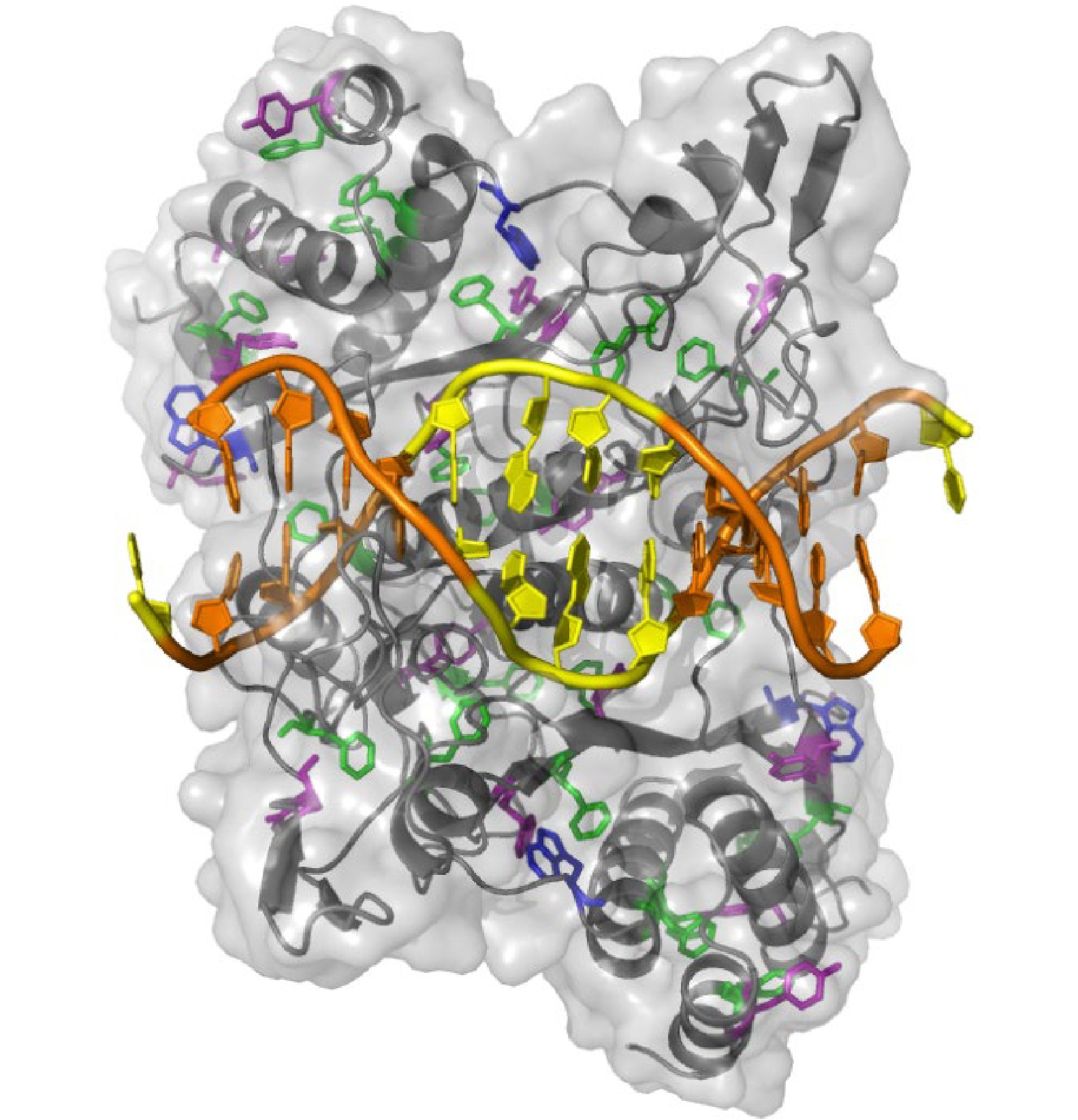
In the present paper we address the general problem of selective electrodynamic interactions between DNA and protein, which is motivated by decades of theoretical study and our very recent experimental findings providing a first evidence for their activation. Inspired by the Davydov and Holstein−Fröhlich models describing electron motion along biomolecules, and using a model Hamiltonian written in second quantization, the time-dependent variational principle is used to derive the dynamical equations of the system. We demonstrate the efficacy of this second-quantized model for a well-documented biochemical system consisting of a restriction enzyme, EcoRI, which binds selectively to a palindromic six-base-pair target within a DNA oligonucleotide sequence to catalyze a DNA double-strand cleavage. The time-domain Fourier spectra of the electron currents numerically computed for the DNA fragment and for the EcoRI enzyme, respectively, exhibit a cross-correlation spectrum with a sharp co-resonance peak. When the target DNA recognition sequence is randomized, this sharp co-resonance peak is replaced with a broad and noisy spectrum. Such a sequence-dependent charge transfer phenomenology is suggestive of a potentially rich variety of selective electrodynamic interactions influencing the coordinated activity of DNA substrates, enzymes, transcription factors, ligands, and other proteins under realistic biochemical conditions characterized by electron−phonon excitations.
The article is downloadable on this link: FrontPhys.
